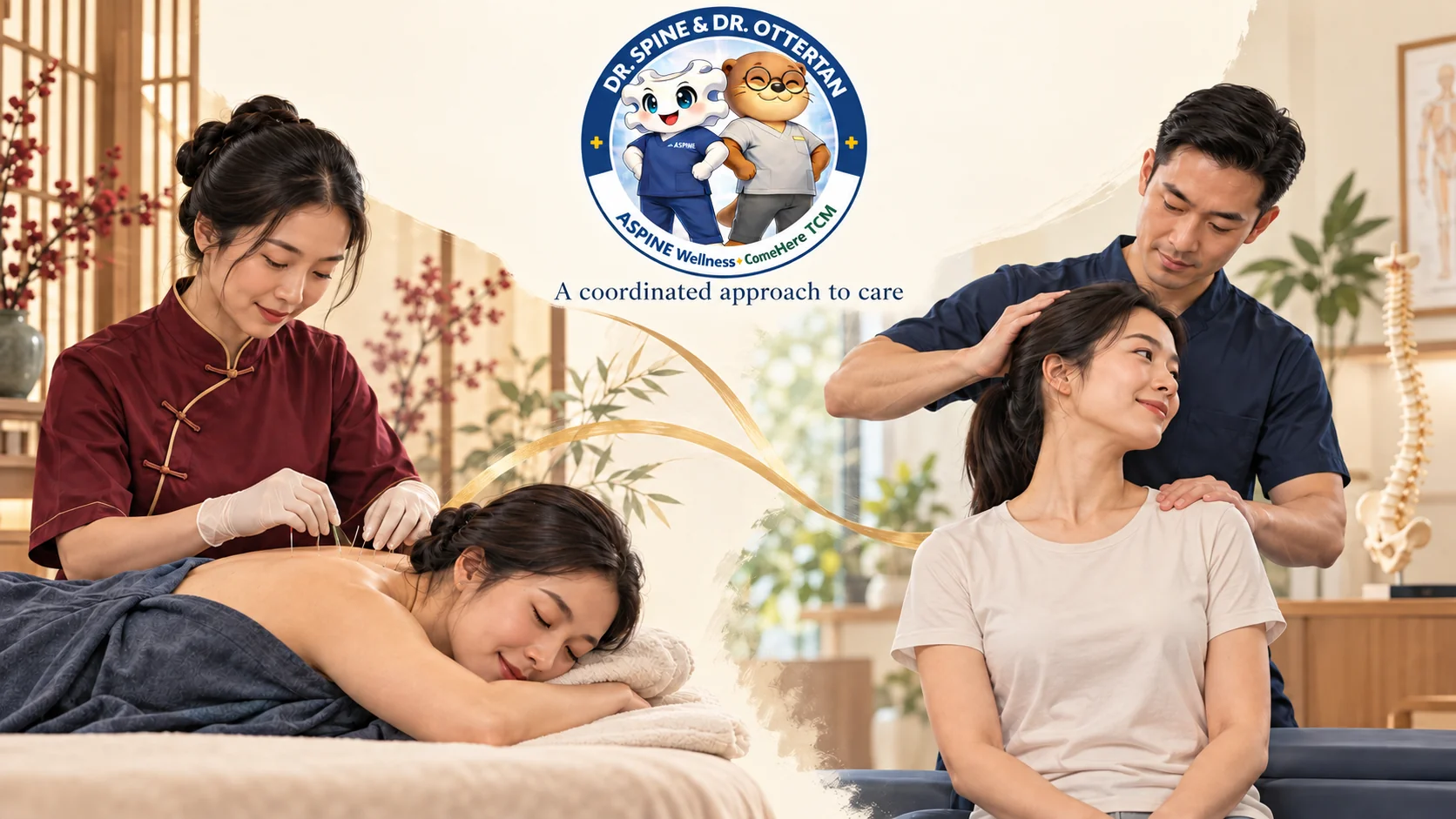
Should you choose chiropractic or Traditional Chinese Medicine (TCM) for neck or back pain? At ASPINE Wellness, our LPPL approach may begin with TCM to help manage suitable acute symptoms, followed by chiropractic care focused on spinal mechanics, posture, movement and rehabilitation. The starting point depends on your assessment.
A painful flare-up and a recurring movement problem can require different priorities. That is why our approach considers both how you feel today and what you need to return to everyday activity.
Key takeaways
- TCM and chiropractic can have different roles within a coordinated care plan.
- In our LPPL pathway, TCM may take the lead during a suitable acute presentation.
- Chiropractic care then focuses on relevant structural and functional findings, alongside exercise and self-management.
- Some people need only one discipline or a different treatment sequence.
- Serious warning signs require medical assessment before either treatment.
Chiropractic vs TCM: what is the difference?
TCM is a broad medical tradition with its own assessment framework. Acupuncture is one of its treatment methods; evidence about acupuncture should not automatically be applied to every TCM treatment.
Chiropractic assessment commonly considers the spine, joints, muscles and movement. Care may include manual treatment, exercise and advice, depending on the findings.
Within ASPINE’s LPPL programme, we coordinate these disciplines around the patient’s current needs.
| Question | TCM’s role | Chiropractic’s role |
|---|---|---|
| What is the initial focus? | Helping manage suitable acute symptoms after assessment. | Assessing relevant spinal, postural and movement concerns. |
| When might it take the lead? | During a painful flare-up when symptom management is the immediate priority. | When the patient is ready to address movement limitations and rehabilitation goals. |
| What guides treatment? | TCM assessment, health history, suitability and response. | Clinical history, examination, functional findings and response. |
| Does everyone need it? | No. | No. |
| What links the two? | A shared plan with reassessment and referral when needed. | A shared plan with reassessment and referral when needed. |
This describes our practice pathway, rather than a rule that TCM only treats acute pain or chiropractic only treats longstanding problems.
Why might TCM come first during a flare-up?
When pain is particularly sensitive, the first goal may be to make everyday activities more manageable.
In suitable cases, our TCM practitioner may lead this stage, choosing treatment according to the assessment. Acupuncture may be considered where appropriate. Research supports its potential usefulness for some pain conditions, although benefits vary by condition and study. [1]
The important distinction is that recent pain still needs assessment. A sudden painful episode is not automatically suitable for TCM—or any hands-on treatment.
Once symptoms become more manageable, we reassess what remains difficult: turning the head, sitting comfortably, bending, walking or returning to exercise.
What does chiropractic care address next?
In the chiropractic phase, we look at the structural and functional concerns relevant to your symptoms.
That may include joint movement, spinal mobility, posture during daily tasks, muscle capacity and tolerance for activity. The plan may combine appropriate manual care with exercises and changes to how you work or move.
“Structural care” should have a clear meaning for the individual patient. It should not be taken to mean that every painful spine is out of place or that an adjustment permanently reshapes it.
Spinal manipulation can help some people with neck or back pain, but effects vary. For low-back pain, guidelines such as NICE recommend considering manual therapy within a treatment package that includes exercise. [2][3]
Feeling better creates an opportunity to rebuild function. That is where rehabilitation matters.
How does the LPPL programme work?
LPPL stands for Long-Term Pain-Free & Posture-Full Life. It is ASPINE Wellness’s coordinated chiropractic and TCM programme.
Our pathway has four practical steps:
- Assess: Understand your symptoms, history, movement and goals, and check whether referral is needed.
- Manage the current symptoms: TCM may lead suitable acute presentations.
- Address remaining limitations: Chiropractic assessment and rehabilitation guide work on relevant mechanical and functional concerns.
- Review progress: Continue, change or stop treatment according to your response.
The programme’s name expresses its goals. Individual outcomes vary.
Does combining chiropractic and TCM work better?
It depends on the condition and the person.
Evidence supporting an individual treatment does not prove that combining treatments—or using them in a particular order—will produce better results.
For example, recommendations on acupuncture differ: WHO conditionally supports needling therapies as part of care for chronic primary low-back pain, while NICE does not recommend acupuncture for low-back pain with or without sciatica. These recommendations also concern different clinical scopes. [3][4]
Our reason for coordinating care is to give each treatment a defined purpose and review whether it is helping.
Useful progress measures include easier movement, improved sleep, greater activity tolerance and better ability to manage symptoms between visits.
When should you see a medical doctor first?
Seek emergency care for symptoms such as sudden severe headache with neurological changes, new bladder or bowel dysfunction with back pain, or rapidly developing weakness.
Significant trauma, worsening weakness, fever with severe pain, or unexplained weight loss also requires prompt medical assessment. [5][6]
Our neck-pain warning-sign guide explains when a routine chiropractic appointment should wait.
Frequently asked questions
Do I have to receive both treatments?
No. An assessment may indicate one discipline, both, or referral elsewhere.
Must the pain disappear before chiropractic care starts?
No fixed pain score determines the transition. Examination findings, symptom sensitivity and your ability to participate guide the timing.
Will I need X-rays?
Not automatically. Imaging is considered when it is likely to affect diagnosis or management.
Can TCM or chiropractic guarantee that pain will not return?
No. The aim is to improve symptoms and function while building a practical plan for activity and self-management.
Related reads
- When NOT to See a Chiropractor for Neck Pain
- Why Does My Lower Back Hurt? Common Causes, Red Flags & What to Do
- Is This Sciatica? Why Pain Travels Down the Leg and What to Do
References
- NCCIH, National Institutes of Health. Acupuncture: Effectiveness and Safety.
- NCCIH, National Institutes of Health. Spinal Manipulation: What You Need To Know.
- NICE. Low back pain and sciatica in over 16s: assessment and management—recommendations.
- WHO. Recommendations for non-surgical management of chronic primary low-back pain.
- NHS. Headaches.
- NHS. Back pain.
Unsure whether to start with chiropractic or TCM?
Start with an assessment. We can explain whether TCM, chiropractic or the coordinated LPPL pathway fits your symptoms and goals.
If you have urgent warning signs, seek medical care rather than waiting for a routine appointment.