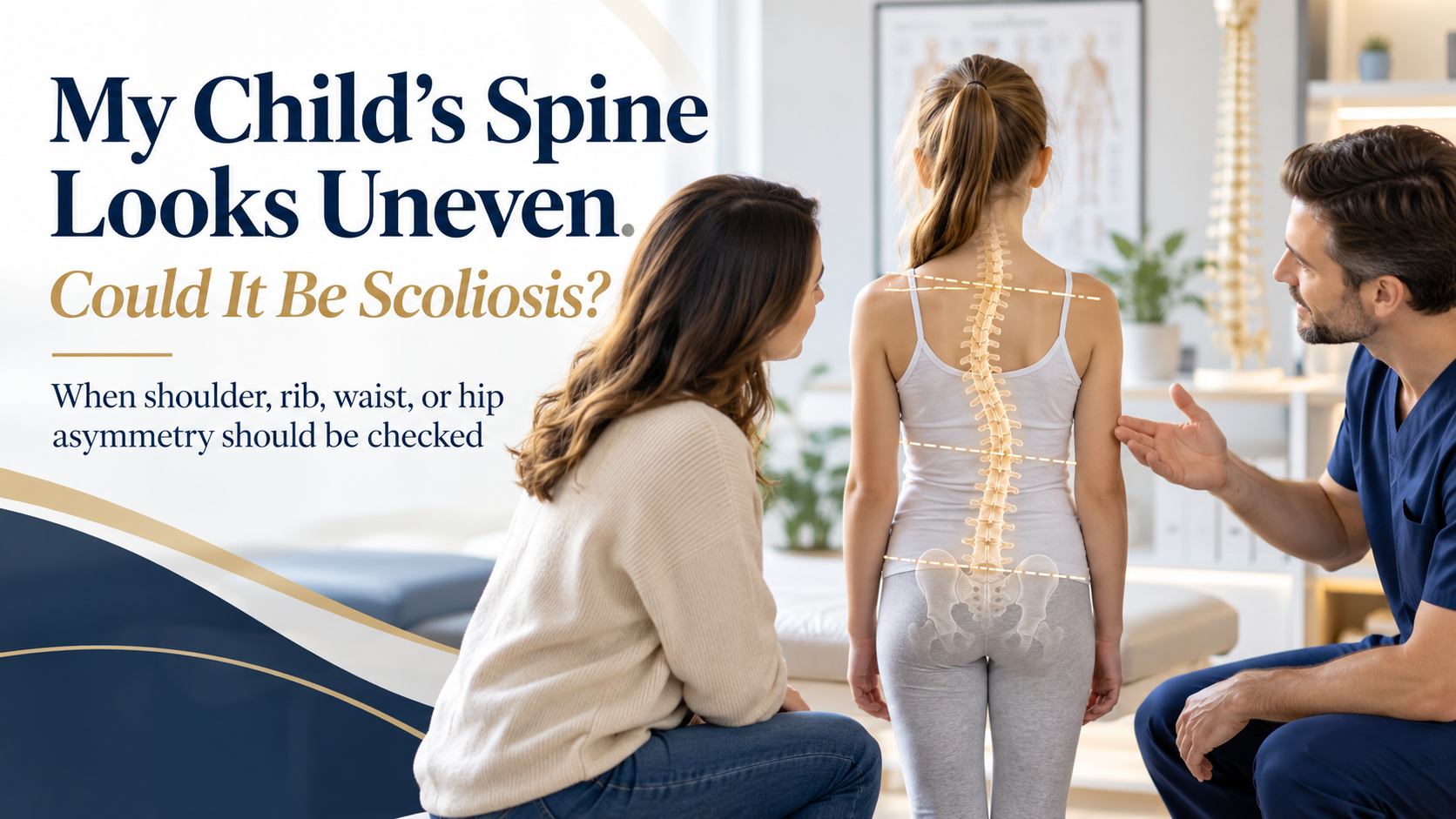
If your child repeatedly looks uneven through the shoulders, ribs, waist or hips, scoliosis is one possible explanation, but it is not the only one. A simple clinical screening can identify signs that deserve closer assessment, while an X-ray is used when needed to confirm scoliosis and measure the curve.
Key takeaways for parents
- Uneven shoulders, shoulder blades, ribs, waist or hips can be signs of scoliosis.
- Not every asymmetry means scoliosis. Standing position, muscle balance and normal body variation can also affect appearance.
- A forward-bend test can reveal trunk or rib asymmetry but does not diagnose scoliosis by itself.
- When scoliosis is suspected, a standing spinal X-ray may be used to measure the Cobb angle.
- Scoliosis in children and adolescents is often painless, especially when mild.
Parents often ask me, “Does my child’s spine look a little uneven?” Sometimes they notice that one shoulder sits higher, one shoulder blade is more prominent, or the waistline looks different from one side to the other.
Sometimes the difference is simply related to how the child is standing. Other times, the parent has noticed a real asymmetry that deserves a closer look.
What does scoliosis look like in a child?
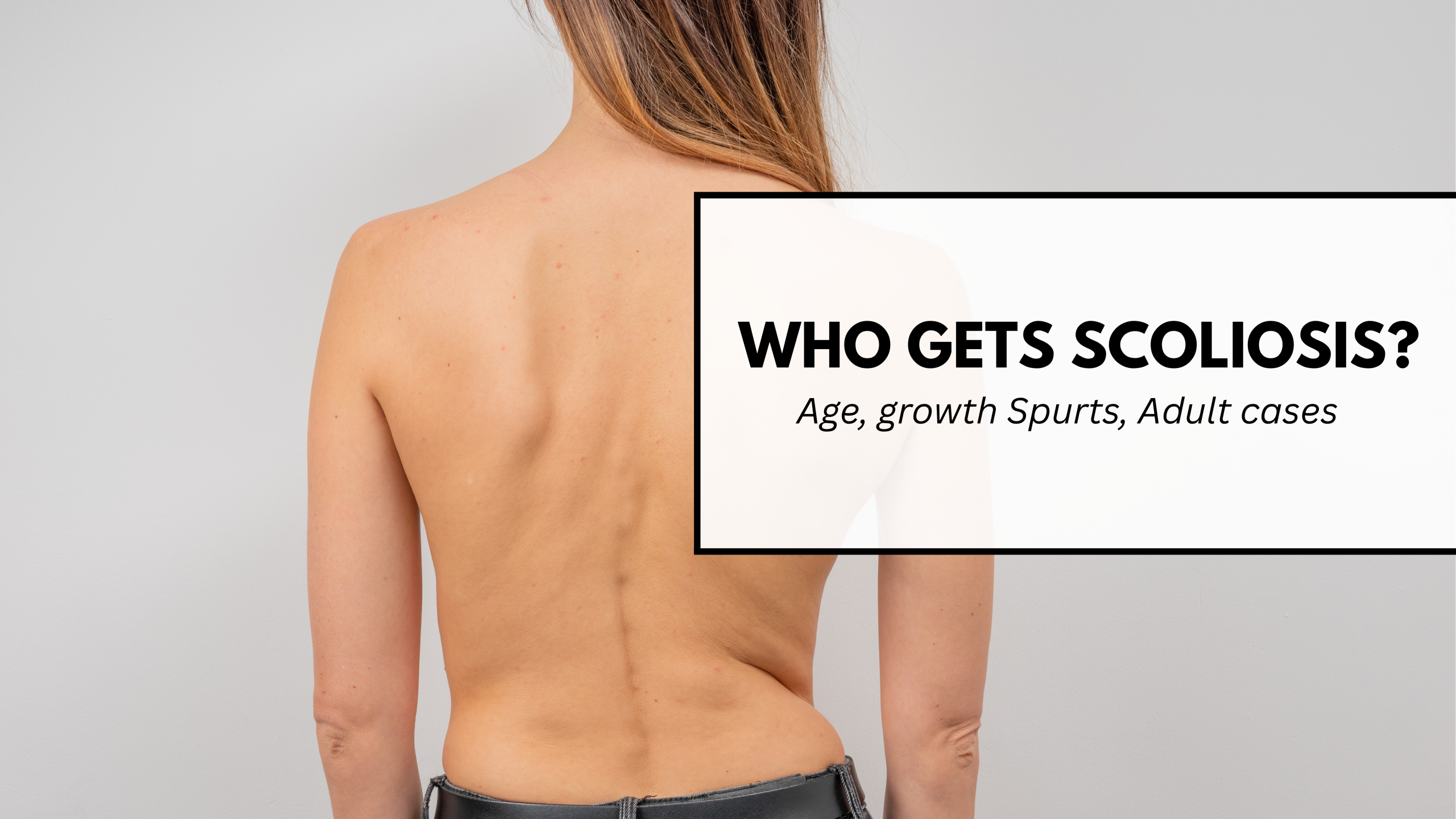
Scoliosis is not simply “bad posture”. It is a three-dimensional spinal deformity in which the spine curves sideways and the vertebrae also rotate. That rotation can change the appearance of the ribs, shoulders, waist and hips.
Common visible signs can include:
- one shoulder sitting higher than the other;
- one shoulder blade appearing more prominent;
- one side of the rib cage appearing higher, especially when bending forward;
- an uneven waistline;
- one hip appearing higher or more prominent; or
- the trunk appearing shifted to one side.
The ASPINE clinical cases section includes examples of spinal and postural asymmetry for parents who want to understand what clinicians may look for.
How is a child checked for scoliosis?
A clinical screening usually starts with observing the child standing from behind, from the side and from the front. The clinician looks at shoulder height, shoulder blades, waist contours, pelvic level and overall trunk balance.
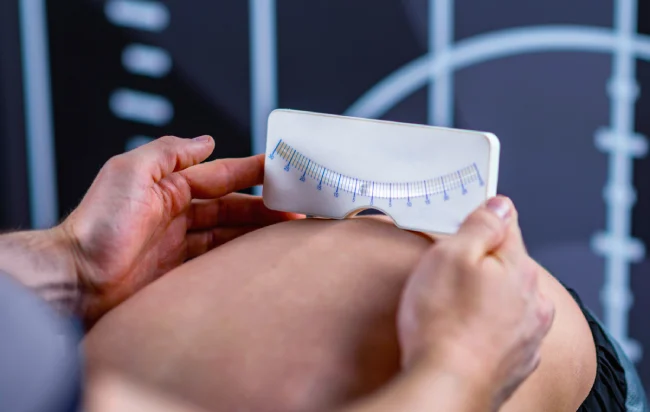
The child may then be asked to perform the Adam’s forward bend test. During this test, the child bends forward while the examiner looks for asymmetry of the ribs or back. A scoliometer may also be used to measure the angle of trunk rotation.
This is useful for screening, but it does not confirm scoliosis on its own.
How is scoliosis confirmed?
When the examination suggests a meaningful spinal curve, a standing spinal X-ray may be recommended. The curve is measured using the Cobb angle.
Adolescent idiopathic scoliosis is generally defined radiographically as a spinal curve of at least 10 degrees in a child or adolescent without a known congenital or neuromuscular cause. Curves below 10 degrees may represent postural asymmetry rather than true scoliosis.
Imaging is not necessary for every child with a slightly uneven posture. The decision depends on the examination findings, the amount of trunk rotation, the child’s growth stage and whether the asymmetry appears persistent or progressive.
Does scoliosis cause pain in children?
Often, no. Mild adolescent idiopathic scoliosis is frequently asymptomatic. That is one reason parents may be the first to notice a visual change rather than the child reporting pain.
Back pain can occur in adolescents with scoliosis, but pain alone does not establish the diagnosis and does not reliably tell us how large a curve is.
When should parents get an uneven spine checked?
An assessment is reasonable when you repeatedly notice the same asymmetry, especially during a period of rapid growth.
It is particularly worth checking if:
- one shoulder or shoulder blade consistently looks higher or more prominent;
- one side of the ribs rises more during a forward bend;
- the waist or hips appear persistently uneven;
- the child seems to lean to one side; or
- the asymmetry appears to be becoming more noticeable over time.
A single photo or one unusual standing position is not enough to diagnose scoliosis. What matters more is whether the asymmetry is reproducible and clinically measurable.
What happens if scoliosis is found?
Management depends on several factors, including the Cobb angle, the child’s age, remaining growth and whether the curve is changing over time. Depending on those factors, care may involve observation, scoliosis-specific exercise, bracing, specialist referral or, for larger progressive curves, surgical consultation.
The important point is that identifying a curve does not automatically mean aggressive treatment is needed. Mild curves may simply be monitored, while growing children with a higher risk of progression may need closer follow-up.
For an overview of how ASPINE approaches scoliosis assessment and management, see our integrated spine and scoliosis services.
You can also read one of ASPINE’s published case summaries on adolescent idiopathic scoliosis management. A case report describes an individual patient and should not be interpreted as proof that the same outcome will occur in every child.
Frequently asked questions
Does an uneven shoulder always mean scoliosis?
No. Shoulder height can vary because of posture, muscle use, leg position and normal anatomical differences. Persistent asymmetry, especially when combined with rib or trunk rotation, is more reason to have the child assessed.
Can I check my child for scoliosis at home?
You may notice visual asymmetry or a rib prominence during a gentle forward bend, but home observation cannot diagnose scoliosis. A trained clinical assessment can determine whether further evaluation is appropriate.
Does my child need an X-ray immediately?
Not necessarily. X-rays are generally considered when clinical findings suggest a meaningful curve or trunk rotation. The examination should guide whether imaging is appropriate.
Is scoliosis caused by poor posture or carrying a heavy school bag?
No. Idiopathic scoliosis is not considered to be caused by poor posture, carrying a heavy bag, sports participation or ordinary daily activities.
Book a scoliosis screening
If you have repeatedly noticed that your child’s shoulders, ribs, waist or hips appear uneven, a scoliosis screening can help determine whether the difference is postural or whether further assessment is warranted.
References
- Scoliosis Research Society. Adolescent Idiopathic Scoliosis. Includes postural screening, Adam’s forward bend testing and radiographic Cobb-angle assessment. Scoliosis Research Society.
- American Academy of Family Physicians. Adolescent Idiopathic Scoliosis. FP Essentials. 2024. AAFP.
- Kuznia AL, Hernandez AK, Lee LU. Adolescent Idiopathic Scoliosis: Common Questions and Answers. American Family Physician. 2020;101(1):19-23. AAFP.
- NHS. Scoliosis. Signs include uneven shoulders, rib prominence and asymmetry of the hips or trunk. NHS.
This article is for general education and does not diagnose scoliosis or replace an individual clinical assessment.
Ready to discuss your symptoms?
Book an assessment with ASPINE Wellness to understand your concerns and explore the appropriate next steps.