
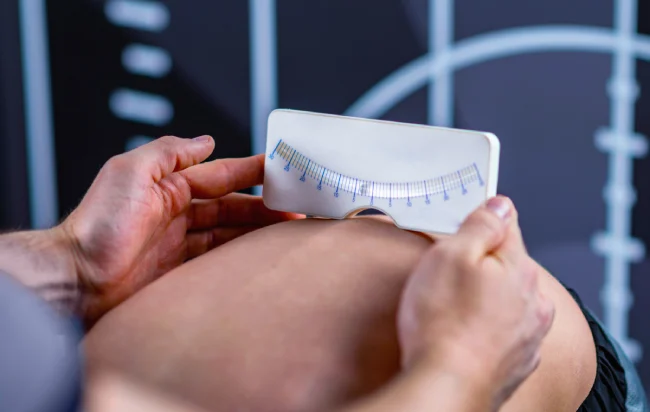
Understanding scoliosis
Scoliosis is a sideways curve of the spine, often with rotation. Uneven shoulders, a prominent shoulder blade or an uneven waist can prompt an assessment. When imaging is indicated, a clinician can measure the curve on a standing X-ray using the Cobb angle. See how scoliosis is diagnosed.
Book an assessment · Browse guides, books and cases
Scoliosis Assessment at Parkway Parade, Singapore
S$108 · 30 minutes · Chiropractic and Scolio-Pilates assessment
ASPINE Wellness provides scoliosis consultations and individual rehabilitation planning at Parkway Parade. If you have noticed uneven shoulders, a prominent shoulder blade or an uneven waist, an assessment can help clarify the next step. Appearance alone does not confirm scoliosis.
Book a Scoliosis Assessment or contact ASPINE on WhatsApp.
Who can have scoliosis?
Scoliosis can occur in children, adolescents and adults. Adolescent idiopathic scoliosis develops during the teenage years, and growth affects the risk of progression. Adult scoliosis may persist from adolescence or develop with age-related spinal changes. Management depends on age, remaining growth, curve characteristics, symptoms and goals.
What happens during your consultation?
Your 30-minute scoliosis assessment includes your health history, posture and movement assessment, muscle-strength testing and review of existing X-rays when available. Bring previous imaging and reports. Your clinician can discuss whether further imaging or specialist referral is appropriate, rather than assuming every patient needs a new X-ray.
We explain the findings, agree on practical goals and develop an individual care plan. Goals may include movement, strength, daily function and symptom management, with curve monitoring where appropriate.
Assess, correct, integrate and reassess
- Assess: understand your spinal presentation, movement, symptoms and priorities.
- Correct: teach individual exercises and positioning strategies where appropriate.
- Integrate: practise useful movement and exercise habits at home and in daily life.
- Reassess: review your progress and adjust the plan according to your response.
Selected plans may combine chiropractic care, corrective exercise, physiotherapy and Scolio-Pilates. Joanne Goh, our Scolio-Pilates Instructor, supports movement, breathing, posture and exercise modification. Jaden Lim Junhong provides physiotherapy as part of our integrated care model. Meet our specialists.
What are the limits of rehabilitation?
There is no guaranteed degree of curve reduction or fixed number of sessions that works for everyone. Rehabilitation does not replace indicated observation, bracing or surgical assessment. For growing patients, timely review matters because treatment decisions depend on curve progression and remaining growth. We discuss referral when care beyond our clinic is appropriate.
Frequently asked questions
Can adults benefit from scoliosis care?
Adult care may focus on symptoms, strength, mobility and daily function. The appropriate approach depends on an individual assessment; a change in the measured curve is not guaranteed.
Do I need a brace?
Some growing patients need bracing. Your age, growth, curve size and progression influence that decision. A rehabilitation programme should not delay an indicated specialist bracing assessment.
Is Scolio-Pilates the same as physiotherapy?
No. Scolio-Pilates provides exercise and movement support. Physiotherapy includes assessment and rehabilitation within the physiotherapist’s professional scope. We help you understand which service fits your needs.
How do I arrange an appointment?
Book a Scoliosis Assessment, or WhatsApp +65 8011 3111 to arrange your consultation. We are at Parkway Parade Office Tower, Level 16, #16-01, 80 Marine Parade Road, Singapore 449269. Get directions to ASPINE Wellness.
Scoliosis guides, books and cases
Start with these guides
- What Is Scoliosis? Signs, Cobb Angle & When to Get Checked
- My Child’s Spine Looks Uneven. Could It Be Scoliosis?
- Who Gets Scoliosis? Age, Growth Spurts, and Adult Cases
- What Is the Best Type of Scoliosis Exercise or Treatment?
- Is Scolio-Pilates® Still for Me After Spinal Fusion Surgery?
Book for parents
My Child Has Scoliosis, by Dr. Juan Villa
Clinical cases
Browse ASPINE’s clinical cases to see examples of individual presentations and care. Outcomes vary by person.
Published scoliosis case reports
Dr. Juan Jesus Villa co-authored these reports on adolescent idiopathic scoliosis.
- Adolescent idiopathic scoliosis and whole-spine alignment (PDF) · Read on Frontiers · Villa et al., Frontiers in Rehabilitation Sciences (2022). The authors followed one adolescent with low back pain through a programme combining exercise, traction and spinal manipulation. They documented changes in spinal alignment and reported that the patient’s pain improved.
- Posture-focused rehabilitation for adolescent idiopathic scoliosis (PDF) · Yu et al., Journal of Spine (2023). The report describes one adolescent with lumbar scoliosis and the changes seen on follow-up X-rays after a 20-week programme of exercise, traction and spinal manipulation.
Related spine research
MRI follow-up of a lumbar disc herniation (PDF) · Villa and Zhao, Journal of Spine (2023). This report documents symptom and MRI changes in one adult with an L5–S1 disc herniation after a 12-week rehabilitation programme.
Each case report describes one patient. Larger comparative studies are needed to determine how much of the change can be attributed to care and what outcomes other patients might expect.

