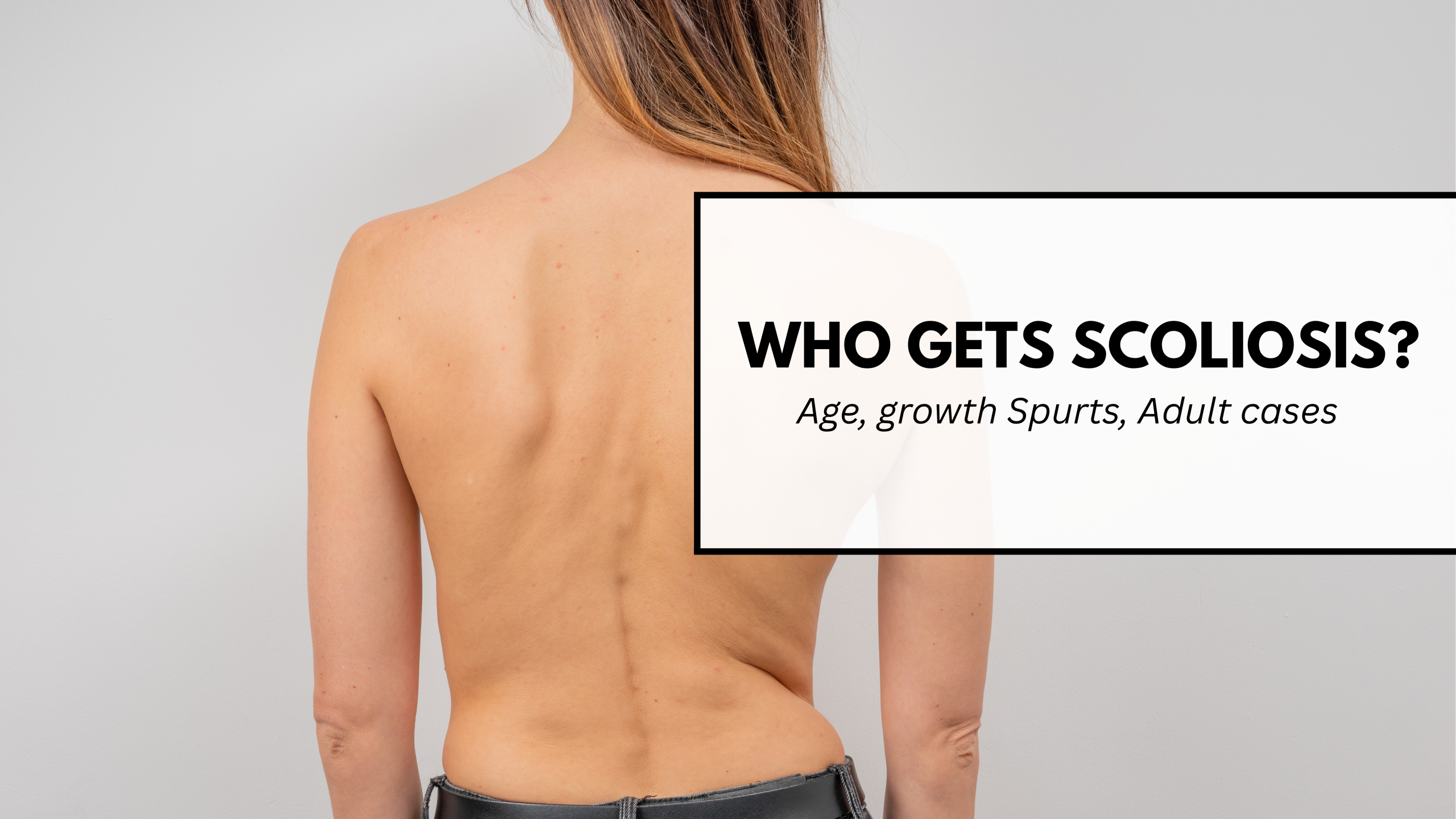
Scoliosis is a three-dimensional spinal condition in which a side-to-side curve measures more than 10 degrees on an X-ray. It can also involve rotation of the spine, which may make one shoulder, rib cage, waist or hip appear more prominent than the other. A physical examination can identify signs that warrant further evaluation, while standing spinal X-rays are used when a diagnosis needs to be confirmed.
Key takeaways
- A spinal curve greater than 10 degrees on X-ray is considered scoliosis.
- Uneven shoulders, ribs, waist or hips can be signs, but appearance alone does not diagnose scoliosis.
- The Adam’s forward bend test and a scoliometer can help identify trunk asymmetry.
- The Cobb angle is measured on an X-ray and helps describe curve size.
- Age, growth remaining and whether the curve is progressing are important when planning care.
What does scoliosis actually mean?
A normal spine is not completely straight when viewed from the side, but when viewed from the front or back it should not have a substantial sideways curve. In scoliosis, the spine curves laterally and may rotate.
The Scoliosis Research Society defines scoliosis as a side-to-side spinal curve measuring more than 10 degrees. Curves below this threshold may be described as spinal or postural asymmetry rather than scoliosis.
What signs can parents or adults notice?
Scoliosis is often first noticed because the body looks asymmetrical. Possible signs include:
- one shoulder appearing higher than the other;
- one shoulder blade appearing more prominent;
- uneven waist creases;
- one hip appearing higher or more prominent;
- the trunk appearing shifted to one side; or
- a rib or flank prominence that becomes more obvious when bending forward.
These signs do not automatically mean a person has scoliosis. Leg-length differences, posture, muscle development and the way someone is standing can also create visible asymmetry.
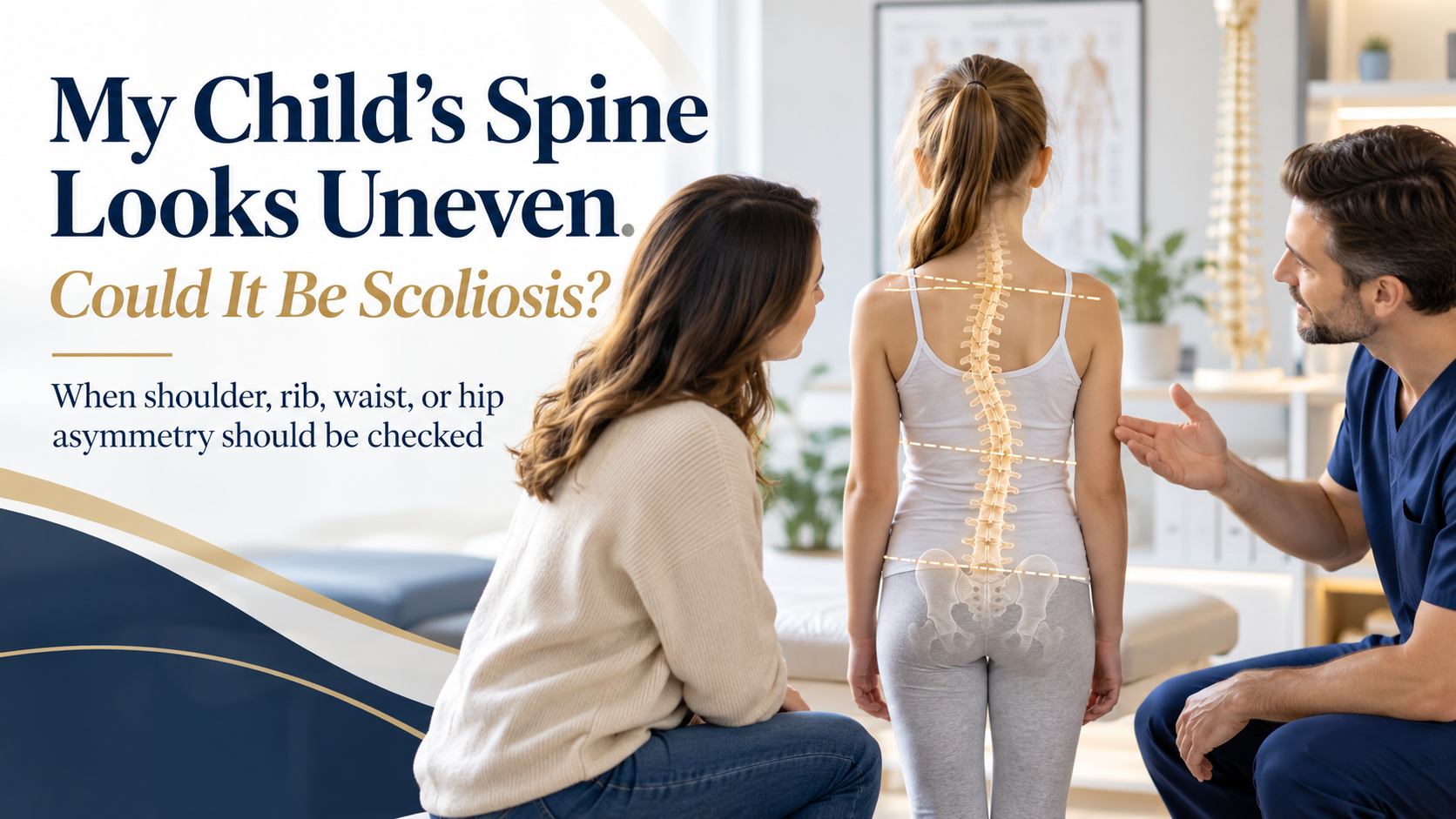
If you are a parent who has noticed asymmetry, read our guide My Child’s Spine Looks Uneven. Could It Be Scoliosis?.
What is the Adam’s forward bend test?
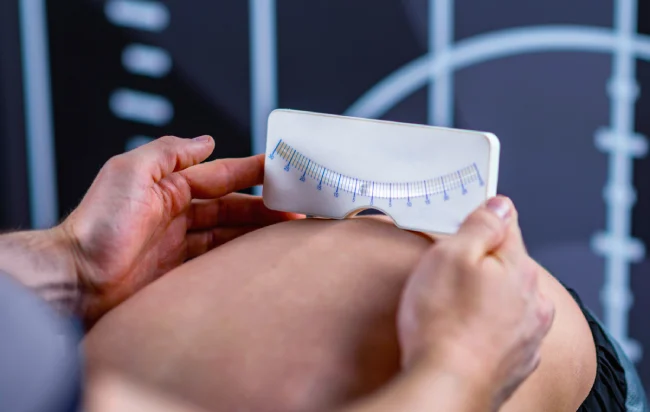
During the Adam’s forward bend test, the person bends forward while the clinician observes the back for rotational asymmetry, such as a rib prominence. A scoliometer may be used to measure the angle of trunk rotation.
This is a screening and assessment tool, not the same as measuring the spinal curve itself. If the clinical findings suggest scoliosis, standing spinal X-rays may be considered to confirm the diagnosis and measure the curve.
What is a Cobb angle?
The Cobb angle is the standard measurement used to describe the size of a scoliosis curve on an X-ray. The clinician identifies the most tilted vertebrae at the top and bottom of the curve and measures the angle between them.
The number is useful, but it is only one part of the picture. Two people with the same Cobb angle may have different ages, growth potential, symptoms, curve patterns and management needs.
Why does growth matter in childhood and adolescence?
Scoliosis curves can progress during periods of rapid growth. That is why age, skeletal maturity and remaining growth are important in children and teenagers. A smaller curve in a child with substantial growth remaining may need closer monitoring than the same-sized curve in someone who is nearly skeletally mature.
For adolescent idiopathic scoliosis, management may include observation, scoliosis-specific exercise, bracing or specialist referral depending on the curve size, growth remaining and evidence of progression. Bracing has evidence for reducing the risk of progression in selected growing adolescents, while scoliosis-specific exercise may have a role in selected mild-to-moderate cases.
Does everyone with scoliosis need treatment?
No. Mild curves may only need monitoring, particularly when growth is nearly complete and the curve is stable. Other patients may benefit from exercise-based care, bracing or specialist assessment.
ASPINE does not recommend care based on the Cobb angle alone. A scoliosis-focused assessment may consider posture, trunk rotation, movement, symptoms, age, growth and available imaging before discussing options.
When appropriate, an exercise-based programme may include Scolio-Pilates® with Joanne Goh alongside other rehabilitation strategies. Exercise does not replace bracing or specialist referral when these are indicated.
When should scoliosis be checked?
Consider an assessment if you notice persistent shoulder, rib, waist or hip asymmetry, a visible trunk shift, or a rib prominence during forward bending. Children and adolescents who are still growing deserve particular attention if these changes appear to be increasing.
New severe pain, neurological symptoms, significant weakness or other unusual features should not automatically be attributed to scoliosis and may require medical evaluation.
Frequently asked questions
Can you diagnose scoliosis just by looking at posture?
No. Posture and the forward bend test can identify signs that warrant further assessment, but scoliosis is defined by the measured spinal curve on an X-ray.
Is a 10-degree curve scoliosis?
A curve greater than 10 degrees is generally considered scoliosis. Curves around the threshold should be interpreted in context because measurement variation can occur.
Does scoliosis always cause pain?
No. Adolescent idiopathic scoliosis is often painless. Significant or unusual pain should be assessed rather than automatically blamed on the curve.
Can scoliosis be managed without surgery?
Many people with scoliosis are managed without surgery. The appropriate plan depends on age, curve magnitude, progression, symptoms and growth remaining. More severe or progressive curves may require specialist surgical assessment.
Book a scoliosis assessment
If you have noticed spinal or postural asymmetry in yourself or your child, an assessment can help determine whether further evaluation or imaging may be appropriate.
Further reading for parents
My Child Has Scoliosis by Dr. Juan Villa provides additional guidance for parents who want to better understand scoliosis, assessment and the questions to ask when planning their child’s care.
View the book on Amazon Singapore
References
- Scoliosis Research Society. Scoliosis.
- Scoliosis Research Society. Diagnosing Scoliosis.
- Kuznia AL, Hernandez AK, Lee LU. Adolescent Idiopathic Scoliosis: Common Questions and Answers. American Family Physician. 2020;101(1):19-23. AAFP.
This article is for general educational purposes and does not replace individual medical assessment.
Ready to discuss your symptoms?
Book an assessment with ASPINE Wellness to understand your concerns and explore the appropriate next steps.